

In agentic commerce, a catalog is no longer a collection of pages. It is a system for answering buying questions with confidence.

Ask an AI assistant for waterproof hiking boots in size 11, under $160, available this week.
It sounds like a search query. It is really a test of the merchant’s operating system.
To answer well, the assistant has to know what “waterproof” means in the catalog, whether size 11 is available right now, which variant meets the price constraint, what delivery can be promised, and where to send the shopper next. A polished product page cannot supply that answer by itself. Neither can a chatbot sitting on top of an old product feed.
This is the part of agentic commerce that tends to disappear beneath the excitement about models, interfaces, and assistant personalities. The constraint is usually more basic: can the business give software a trustworthy answer to a buying question?
That answer comes from the catalog.
Most commerce teams still treat the catalog as a presentation layer. It populates product pages, category grids, campaign emails, and paid-shopping feeds. That made sense when people did the comparison work. An agent changes the job. It must translate a human request into a viable offer, make a recommendation it can stand behind, and hand the buyer to a purchase path without making them start over.
For that, the catalog has to act less like a set of pages and more like a decision engine.
A title, a hero image, and a long description may attract a browser. They do not support a purchase decision. The meaningful unit is a live offer: a particular product or SKU with a current price, availability, relevant constraints, and a stable route to buy. SuggestAPI’s catalog-discovery checklist makes a similar practical case. A discovery system needs current, structured facts. It cannot safely infer them from a storefront built for visual browsing.
A live offer is the new atomic unit of commerce
A merchant can have strong merchandising and still fail this test.
Take a shoe catalog that returns a parent product when an assistant asks for a men’s waterproof boot in black, size 11. The product looks right. The assistant recommends it. The shopper reaches the page and finds size 11 sold out, black unavailable, and the sale price attached to another variant.
The recommendation was not just incomplete. It was commercially wrong.
For a person, that creates friction. For an agent, it erodes trust.
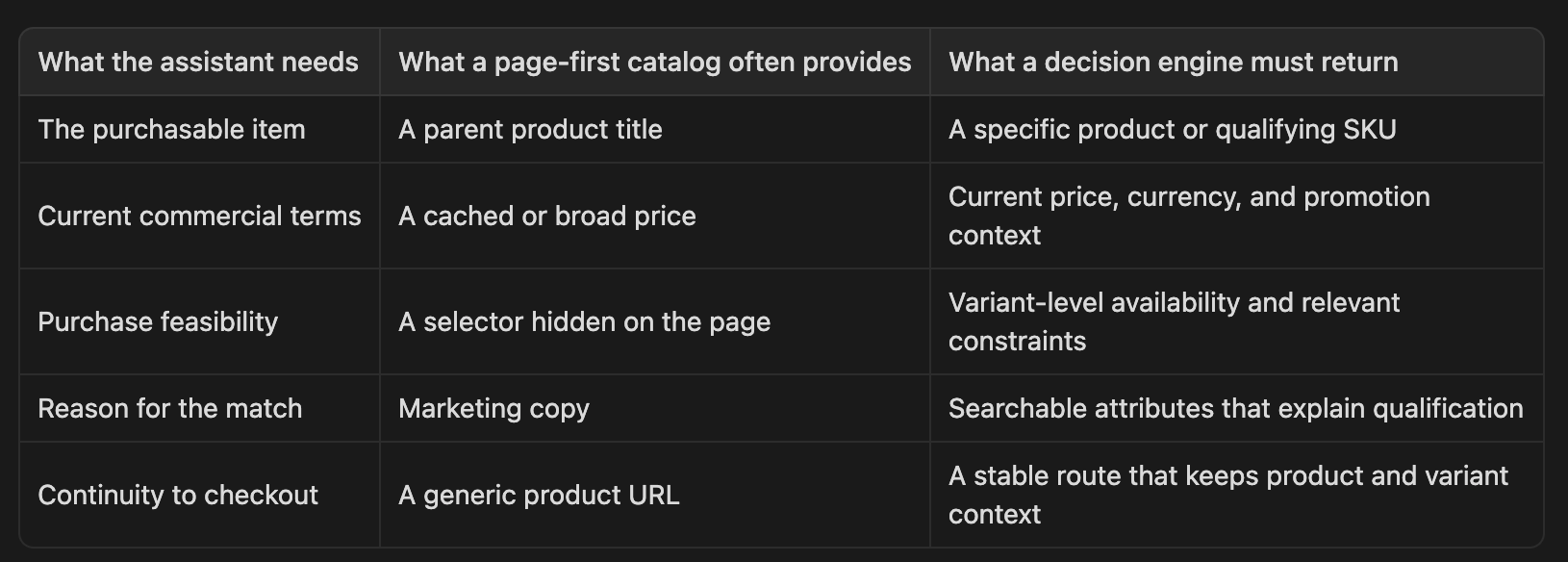
This does not mean opening every internal system to outside software. It means defining a trusted commerce contract. An assistant does not need direct access to the ERP, PIM, OMS, or pricing service. It needs an accurate, governed answer that reflects the commercial truth those systems produce.
That is a leadership choice before it is an integration project.
The work is making product truth usable
Catalog quality has always mattered. Agents simply expose its weak spots sooner.
People are very good at compensating for missing information. They can interpret a clumsy title, guess that “weatherproof” probably means “water resistant,” dig into a sizing guide, or call support when a compatibility claim feels vague. An agent should not make those leaps. It cannot do so reliably.
If a customer asks for a replacement filter that fits a specific appliance, compatibility must exist as a queryable relationship. If they need a gift delivered before Friday, delivery conditions cannot be buried in a support article. If a business customer needs a bulk pack, the minimum order quantity and pack size need to be part of the offer, not trapped inside a PDF.
The organizations that take this seriously will stop treating product data as back-office tidying. They will treat it as a revenue system.
That changes the questions a commerce leader asks. Do not ask whether the team has “AI-ready content.” Ask whether a machine can separate a product requirement from a marketing phrase. Do not ask whether every SKU is indexed. Ask whether the attributes that determine a purchase are indexed. And do not celebrate a chatbot answer until you know it survived the handoff to the store.
There is a useful divide here.
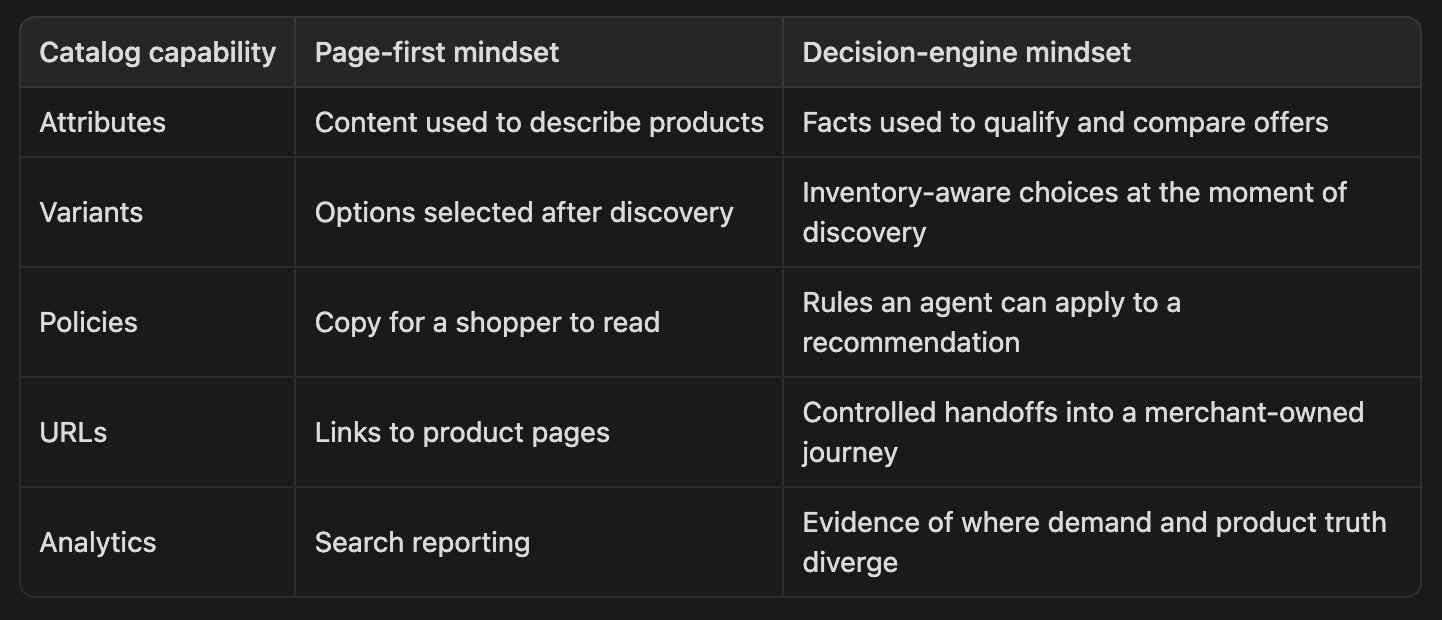
A catalog is ready for agents when the third column is true in the real questions shoppers ask. Not in a slide deck. In production.
Variant data is where the promise breaks
The most expensive catalog mistake is modeling the product at the wrong level of detail.
Buyers rarely want a generic item. They want the right version of it. Size, capacity, fit, color, material, voltage, handedness, country availability, compatible device, pack count, and delivery window are not decorative details. Often, they are the decision.
Yet many storefronts still hide this information behind selectors, merchandising logic, or page scripts. That is workable when a person has time to browse. It does not hold when an assistant needs to answer a constrained request in a few seconds.
That is why a broad “product search API” is not automatically a useful agent interface. When search returns a parent product and the buyer needs a qualifying variant, it leaves the agent to guess. Guessing is not a feature.
The remedy does not always require a replatform. Often it starts with agreement on the variant-level facts that determine purchase eligibility, followed by making those facts available in the discovery layer at the same freshness as the storefront. If the product team would hesitate to show an attribute in a checkout confirmation, an assistant should not use it as the basis for a recommendation.
The handoff is part of the recommendation
A correct answer can still create a poor experience.
Commerce teams often focus on discovery and treat the click-through as somebody else’s problem. That boundary no longer holds. If an agent says, “This is the one,” and then sends the customer to a generic category page, a broken product URL, or an unselected configuration, the shopper has to repeat the work. It feels like a bait and switch, even when nobody intended one.
The merchant should keep control of checkout, brand presentation, payment, policies, and the customer relationship. Agentic discovery does not require giving any of that away. It does require a dependable bridge from recommendation to a merchant-owned next step.
A strong handoff includes canonical product identity, a current route, and, where the platform permits it, enough state to resolve the recommended configuration. The customer should arrive at the answer, not at the start of another search session.
That is where agentic commerce stops being a novelty and starts becoming conversion infrastructure.
The catalog needs an owner, not another dashboard
It is tempting to hand this to an AI team. That would be a mistake.
No single group owns every truth required for a commerce recommendation. Merchandising shapes how products are grouped and explained. Operations owns inventory and fulfillment constraints. Data teams govern identifiers and feeds. Engineering owns interfaces and response time. Commerce leaders own the customer outcome and the revenue outcome.
An assistant exposes the gaps between those groups.
The practical response is not a committee that meets once a quarter. It is a shared definition of a live offer, clear ownership for each field, an agreed measure of freshness, and a response plan for recommendations that cannot be verified. The ambition is deliberately simple: reliable answers to high-intent buying questions.
Start with twenty of those questions. Use language that customers really use. Include the awkward requests: replacement parts, firm budgets, incompatible variants, delivery deadlines, regulated products, multi-pack orders, and out-of-stock substitutions. Run each question through the same path an assistant would use. Then follow every result through to the storefront.
The failures will be plain. Some answers will be too broad. Some rules will be stuck in copy. Some stock states will be out of date. Some URLs will send shoppers into a dead end. Each issue looks like a small catalog problem. Together, they are a revenue-system problem.
The brands that win will be easy for software to buy from
The next phase of commerce will not be won by the brand that announces an AI assistant first. It will be won by the brand whose offers are easiest for intelligent software to understand, verify, compare, and route into a transaction.
That demands more than searchable pages. It demands current product truth, explicit decision-level data, and feedback that shows where genuine buying intent runs into a weak answer.
Build that foundation and every future interface has something useful to work with: site search, a service agent, a marketplace integration, a shopping assistant, or an experience nobody has built yet.
So the first question is not, “Which AI assistant should we launch?”
It is, “Can our catalog give a correct answer when the buyer is specific?”